202,573 results
-
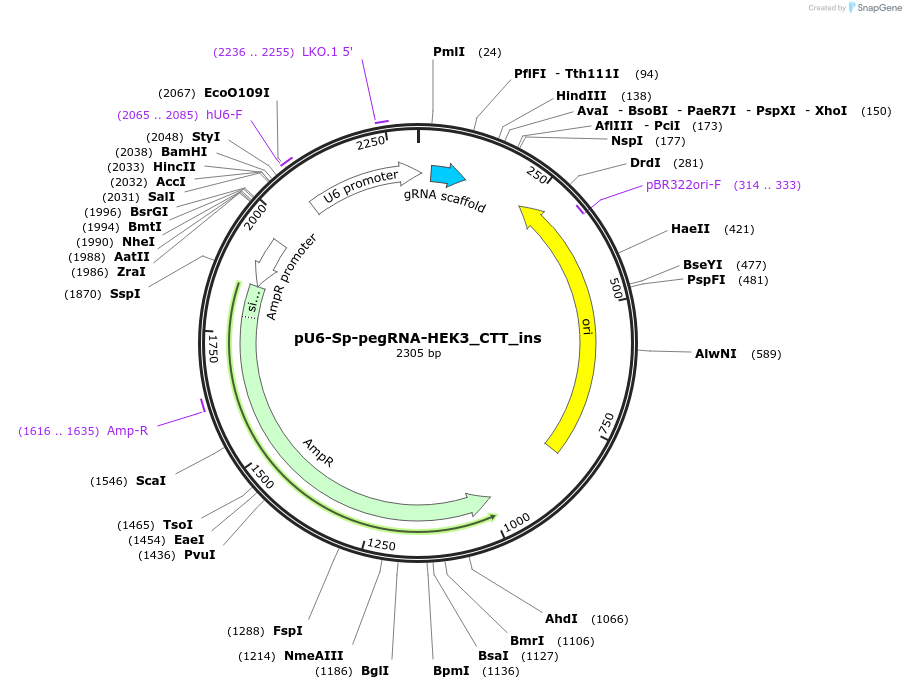
Plasmid#86708PurposeMakes CRISPR gRNAs detectable by single-cell RNA-seq. The gRNA is expressed as part of the puromycin resistance mRNA transcribed by RNA Pol II and in its functional form from the hU6 promoter.DepositorInsertEF1a-Puro-WPRE-hU6-gRNA
UseCRISPR and LentiviralExpressionMammalianPromoterhU6Available sinceFeb. 9, 2017AvailabilityAcademic Institutions and Nonprofits onlyCited by -
G-CaMP3
Plasmid#22692Purposea single-wavelength GCaMP2-based genetically encoded calcium indicatorDepositorPublicationInsertG-CaMP3
ExpressionMammalianMutationN363D mutation (increased fluorescence)Available sinceNov. 13, 2009AvailabilityAcademic Institutions and Nonprofits onlyCited by -
G-CaMP3
Plasmid#22692Purposea single-wavelength GCaMP2-based genetically encoded calcium indicatorDepositorPublicationInsertG-CaMP3
ExpressionMammalianMutationN363D mutation (increased fluorescence)Available sinceNov. 13, 2009AvailabilityAcademic Institutions and Nonprofits onlyCited by -
pLKO.1 neo
Plasmid#13425Purpose3rd gen lentiviral backbone for cloning and expression of new shRNA sequences. Uses neomycin for selection.DepositorInsertnon-hairpin 18bp
UseLentiviral and RNAiExpressionMammalianPromoterU6 promoterAvailable sinceDec. 22, 2006AvailabilityAcademic Institutions and Nonprofits onlyCited by -
pLKO.1 neo
Plasmid#13425Purpose3rd gen lentiviral backbone for cloning and expression of new shRNA sequences. Uses neomycin for selection.DepositorInsertnon-hairpin 18bp
UseLentiviral and RNAiExpressionMammalianPromoterU6 promoterAvailable sinceDec. 22, 2006AvailabilityAcademic Institutions and Nonprofits onlyCited by -
HRE-luciferase
Plasmid#26731PurposeLuciferase reporter construct containing three hypoxia response elements (24-mers) from the Pgk-1 gene.DepositorInsertHypoxia Responsive Elements (3)
UseLuciferaseTagsLuciferaseExpressionMammalianAvailable sinceNov. 10, 2010AvailabilityAcademic Institutions and Nonprofits onlyCited by -
HRE-luciferase
Plasmid#26731PurposeLuciferase reporter construct containing three hypoxia response elements (24-mers) from the Pgk-1 gene.DepositorInsertHypoxia Responsive Elements (3)
UseLuciferaseTagsLuciferaseExpressionMammalianAvailable sinceNov. 10, 2010AvailabilityAcademic Institutions and Nonprofits onlyCited by -
pAAV-FLEX-tdTomato (AAV Retrograde)
Viral prep#28306-AAVrgPurposeReady-to-use AAV Retrograde particles produced from pAAV-FLEX-tdTomato (#28306). In addition to the viral particles, you will also receive purified pAAV-FLEX-tdTomato plasmid DNA. Cre-dependent (FLEX) tdTomato expression. These AAV were produced with a retrograde serotype, which permits retrograde access to projection neurons. These AAV preparations are suitable purity for injection into animals.DepositorPromoterCAGTagstdTomato (Cre-dependent)Available sinceDec. 12, 2017AvailabilityAcademic Institutions and Nonprofits only -
pU6-(BbsI)_CBh-Cas9-T2A-mCherry
Plasmid#64324PurposeExpression vector for sgRNAs cloned into the BbsI sites and for expression of Cas9 linked to mCherry via a T2A peptideDepositorInsertsCas9
sgRNA cassette
UseCRISPRTags3xFLAG, NLS, and T2A-mCherryExpressionMammalianPromoterCBh and U6Available sinceSept. 2, 2015AvailabilityAcademic Institutions and Nonprofits onlyCited by -
pLJC5-Tmem192-3xHA
Plasmid#102930PurposeLentiviral expression of a lysosomal tag (Tmem192-HA)DepositorAvailable sinceNov. 29, 2017AvailabilityAcademic Institutions and Nonprofits onlyCited by -
pmiRFP670-N1
Plasmid#79987PurposeMonomeric near-infrared fluorescent protein miRFP670 in mammalian plasmidDepositorInsertmiRFP670
ExpressionMammalianPromoterCMVAvailable sinceJuly 20, 2016AvailabilityAcademic Institutions and Nonprofits onlyCited by -
pSico
Plasmid#11578PurposeCre-regulated lentiviral shRNA vector. Cre addition causes EGFP to be recombined out of the construct, activating shRNA expression.DepositorTypeEmpty backboneUseCre/Lox, Lentiviral, and RNAiExpressionMammalianAvailable sinceJuly 19, 2006AvailabilityAcademic Institutions and Nonprofits onlyCited by -
pSico
Plasmid#11578PurposeCre-regulated lentiviral shRNA vector. Cre addition causes EGFP to be recombined out of the construct, activating shRNA expression.DepositorTypeEmpty backboneUseCre/Lox, Lentiviral, and RNAiExpressionMammalianAvailable sinceJuly 19, 2006AvailabilityAcademic Institutions and Nonprofits onlyCited by -
pLTR-RD114A
Plasmid#17576DepositorPublicationInsertRD114 envelope glycoprotein
UseLentiviralExpressionMammalianAvailable sinceApril 14, 2008AvailabilityIndustry, Academic Institutions, and NonprofitsCited by -
pLTR-RD114A
Plasmid#17576DepositorPublicationInsertRD114 envelope glycoprotein
UseLentiviralExpressionMammalianAvailable sinceApril 14, 2008AvailabilityIndustry, Academic Institutions, and NonprofitsCited by -
pCXWB-EBNA1
Plasmid#37624PurposeNon-replicating episomal expression of EBNA1, which enhances transfection efficiency and expression from episomal plasmidsDepositorAvailable sinceDec. 3, 2012AvailabilityAcademic Institutions and Nonprofits onlyCited by -
pCXWB-EBNA1
Plasmid#37624PurposeNon-replicating episomal expression of EBNA1, which enhances transfection efficiency and expression from episomal plasmidsDepositorAvailable sinceDec. 3, 2012AvailabilityAcademic Institutions and Nonprofits onlyCited by -
myc-Rictor corrected
Plasmid#11367PurposeMammalian expression of myc tagged human RICTORDepositorAvailable sinceApril 27, 2006AvailabilityAcademic Institutions and Nonprofits onlyCited by -
myc-Rictor corrected
Plasmid#11367PurposeMammalian expression of myc tagged human RICTORDepositorAvailable sinceApril 27, 2006AvailabilityAcademic Institutions and Nonprofits onlyCited by -
pAAV-CAG-GFP
Plasmid#37825PurposeAAV-mediated expression of GFP under the CAG promoterDepositorHas serviceAAV CAP-B10, AAV CAP-B22, AAV MaCPNS1, AAV MaCPNS2, AAV PHP.eB, AAV Retrograde, AAV Retrograde trial size, AAV1, AAV1 trial size, AAV11, AAV11 trial size, AAV2, AAV2 trial size, AAV5, AAV5 trial size, AAV6, AAV6 trial size, AAV8, AAV8 trial size, AAV9, AAV9 trial size, and AAV9-X1.1InsertGFP
UseAAV; Adeno-associated virusExpressionMammalianMutationN/APromoterCAGAvailable sinceAug. 8, 2012AvailabilityAcademic Institutions and Nonprofits onlyCited by